

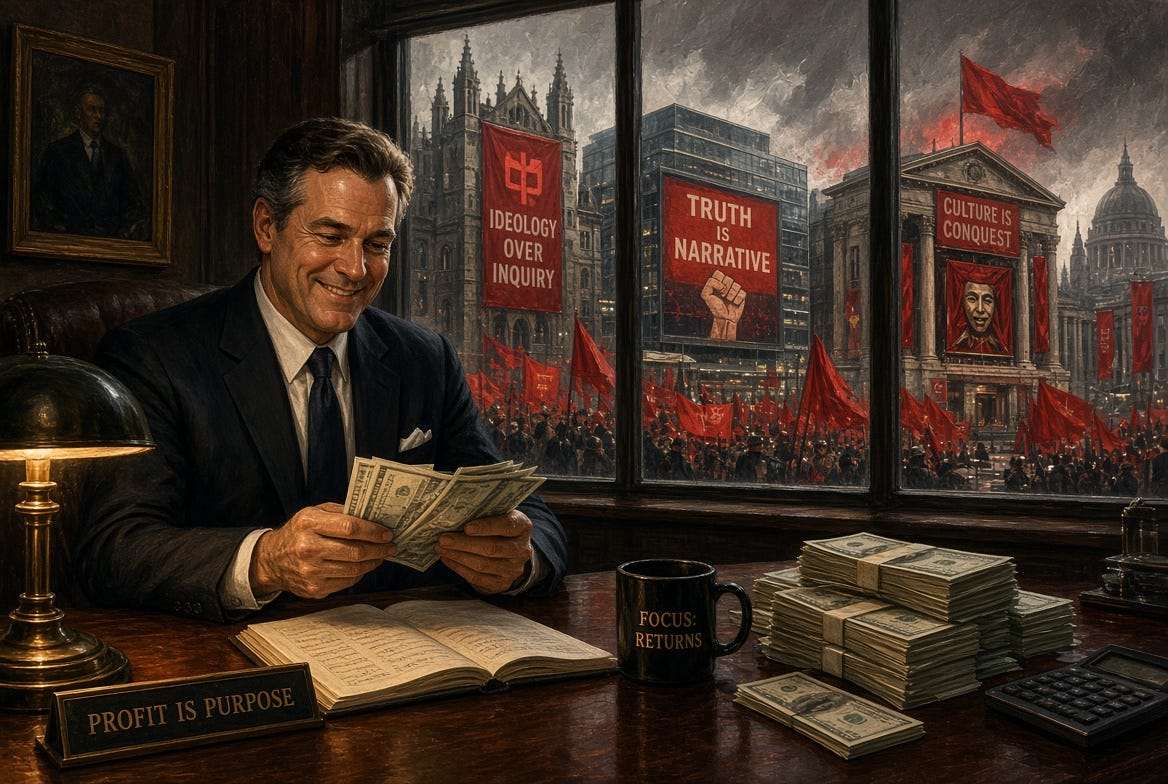
In textbooks, and in the minds of the credentialed semi-literates who populate our universities, the difference between capitalism and communism comes down to a mode of production, that is, to who owns the means of production, private hands on one side and the state on the other. This schoolroom definition is so comfortable that even the enemies of communism repeat it without noticing that they are reciting the adversary's catechism, which is precisely what Gramsci would have called, with the smile of a man who won without firing a shot, hegemony.
The trouble is that total state ownership of the economy has never existed and never will, because it is an economic impossibility pure and simple. Ludwig von Mises demonstrated as much back in 1920, and the communists, after a few feeble kicks, never managed to refute him. That is exactly why, in every communist regime in history, a considerable slice of the economy remained in private hands. At first it lived in a clandestinity tolerated by governments that knew everything would collapse without it, and later it came out into the open under the name of perestroika or whatever euphemism the moment required.
Now, if real communism lives so comfortably alongside private capital, then the much-advertised collective ownership of the means of production was never more than a carrot dangling before the donkey, a hypnotic pretext for marching the faithful toward a paradise postponed unto the ages of ages. Broadly speaking, what these regimes always did was give up on the economy, which is untamable by nature, and concentrate on whatever could be controlled with little effort, namely parties, the press, schools, religion and cultural institutions. Master half a dozen channels and you master the whole of society without ever having to fix the price of bread.
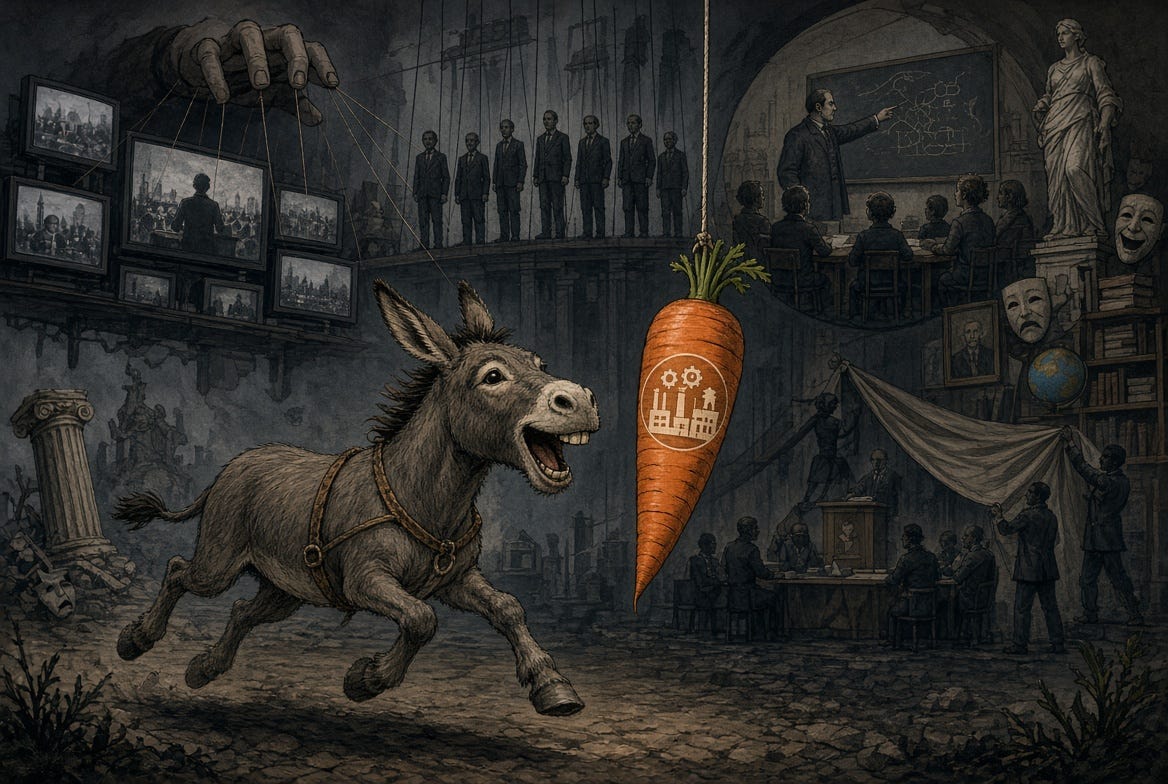
Hence betraying its promises is the very condition of the program's survival, and not a deviation from it. And it is this same slippery character that fools the businessman, dear reader. Because he lives by the economy and thinks through the economy, he ends up buying the Marxist thesis that everything is decided by the mode of production, and so he concludes that as long as he can turn a profit, communism remains a vague and distant threat. Meanwhile the state goes on occupying culture, politics and civil society, until the only freedom left is the freedom to make money. That holds only so long as he behaves like a good boy and never dares to spend his money buying other freedoms, because at the first sign of an opinion of his own someone will remind him, with the utmost courtesy, that his company is a provisional and revocable concession.
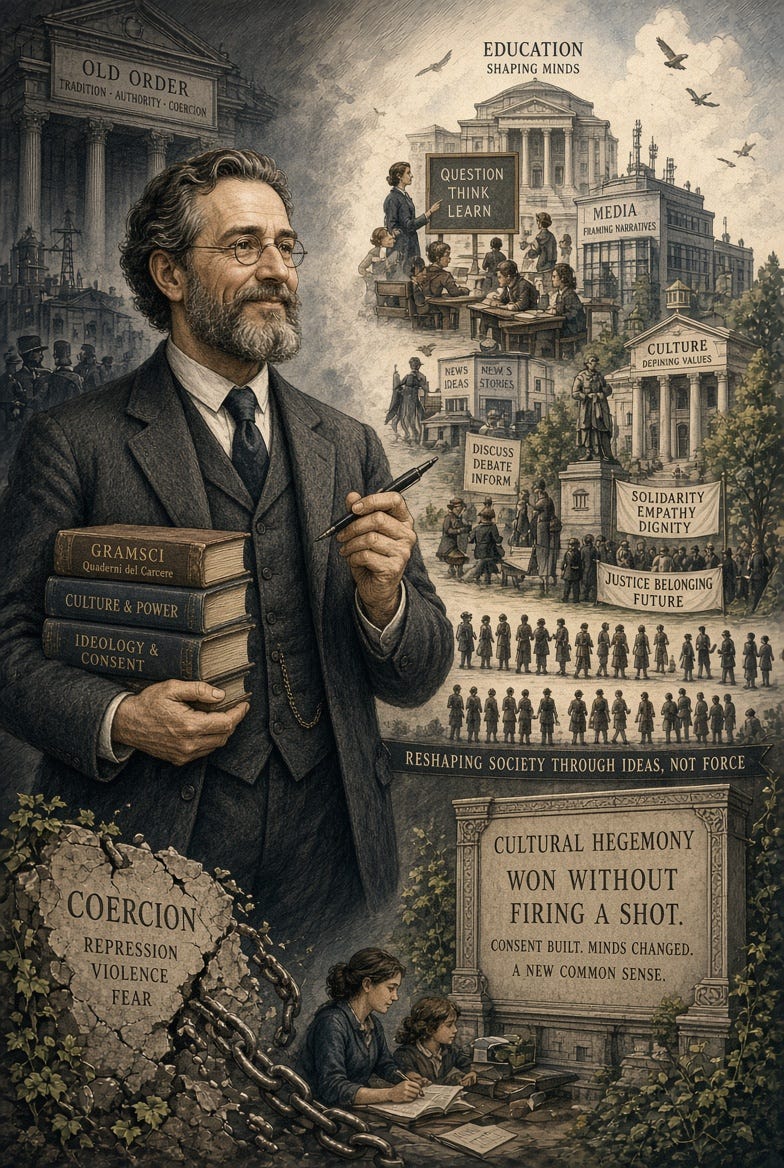
Olavo de Carvalho wrote this in 2014, when nearly everyone still believed the danger lived on the balance sheets of state enterprises. The more seasoned communists laughed quietly at anyone who imagined them interested in factories, since the target was always minds, hearts and habits.
And by every indication, they already have them.
Good read 👍
It’s rhetorical capture. Political Economy Ideology only exists as a device for misrule.