
THE CHEAPEST WEAPON IS A BURNING BUILDING
From the Reichstag fire to January 6th in Washington, the false flag playbook nobody wants to read

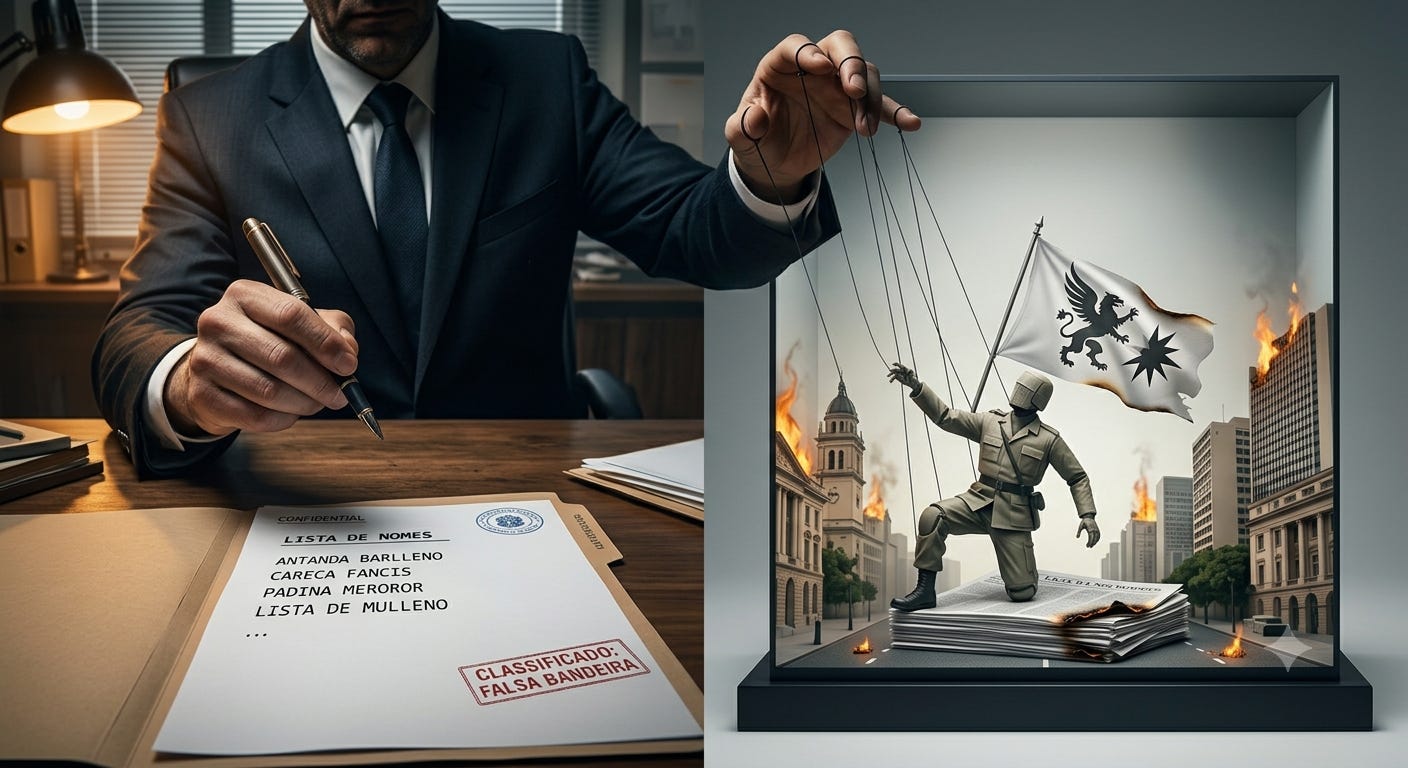
There is a kind of war that dispenses with armies, inasmuch as its battlefield is the public imagination. It never appears in police reports, leaves no shell casings on the ground and no torn uniforms behind, and yet it topples governments, manufactures martyrs, elects presidents and buries reputations with an efficiency that would make any armored division blush. The manuals call it a false flag operation, an expression inherited from piracy, when ships would hoist a rival's colors so as to approach their prey without raising alarm. Vexillology, the gentle science of cataloguing flags, never suspected that its most profitable chapter would be written in invisible ink.
But what is a false flag, after all? And if the device is so vulgar, why do so few recognize it while it happens? It is worth defining the object before dissecting it. The operation consists in provoking, staging or instrumentalizing an event while attributing its authorship to an adversary, with the aim of mobilizing public emotion, justifying repression and harvesting the political dividend. The Spanish journalist Eric Frattini, who spent years mining declassified archives to write *Manipulating History*, arrived at a conclusion of disconcerting simplicity, insofar as strategic lying has never been an aberration of politics but rather one of its most traditional instruments. Machiavelli, who never had the bad taste to be a hypocrite, had already taught that governing is above all the administration of appearances, so that Frattini merely updated the Florentine with an archival stamp and a bureaucrat's signature. The sophisticated model, moreover, is rarely fabricated whole, since it blends real facts with deliberate narrative manipulation, and it is precisely for that reason that it withstands debunking so well. It is simpler than it appears, dear reader. Don't run off.
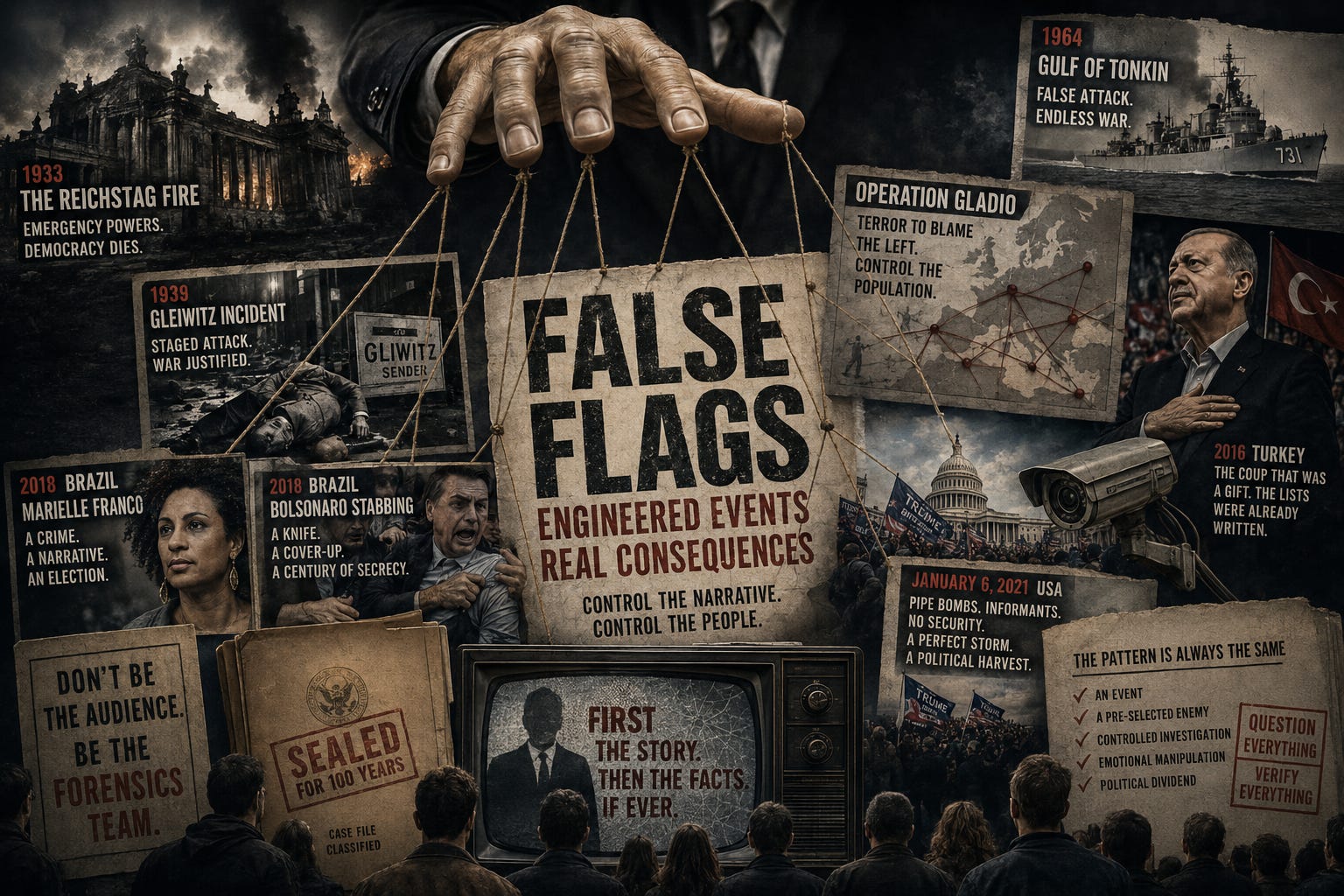
The genealogy rests in the books, not in the internet's murkier forums. In February 1933 the German Parliament burned under circumstances historians debate to this day, although nobody debates who profited from the ashes, for Hitler signed within forty-eight hours the decree that suspended civil liberties and buried the Weimar Republic. Six years later, on the eve of the invasion of Poland, SS men dressed in Polish uniforms attacked a German radio station at Gleiwitz and scattered across the scene the corpses of concentration camp prisoners, a production signed by Reinhard Heydrich with a set designer's care. The final budget came to sixty million dead. Ideas have consequences, and so do pretexts. In 1964 the American government announced that North Vietnamese torpedo boats had attacked its destroyers in the Gulf of Tonkin, Congress authorized the escalation, and three million Vietnamese along with fifty-eight thousand Americans paid the bill for a second attack that Robert McNamara, years before becoming the penitent star of an award-winning documentary, would admit never took place. Operation Gladio, a clandestine network tied to NATO, seeded terror attacks across Western Europe while attributing them to the communist left, and its existence only left the territory of paranoia when Giulio Andreotti confirmed it before the Italian Parliament in 1990.
The most instructive case, however, is the Turkish one. In the early hours of July 15th, 2016, tanks occupied Ankara and Istanbul, fighter jets buzzed the Parliament and a military faction declared it had seized power, whereas Erdogan, holding a cell phone up to the cameras, summoned the population into the streets. The coup lasted hours; the purge, years. In less than a day the government already possessed complete and detailed lists of judges, prosecutors, professors, journalists and officers to be arrested or dismissed, more than one hundred and fifty thousand people in all, at a speed no bureaucracy on the planet achieves without prior rehearsal. Erdogan himself described the episode as a gift from God. Rare candor in a politician, one must concede. Analysts the world over have since pointed to the uncomfortable alternative, for either the government knew and let it happen, or it helped it happen, and in both scenarios the outcome was identical, namely a sultanate with an electoral veneer. The Turkish Reichstag burned in July, and the lists were already written.
Notice, dear reader, that the pattern displays an almost Franciscan economy, inasmuch as it requires only an event, an enemy designated in advance and a power eager to expand. Well then, the phenomenon respects neither hemispheres nor work visas, for both the empire and its tropical laboratory have supplied abundant material over the past decade.
Let us begin in the tropics. The assassination of Marielle Franco, a Rio de Janeiro councilwoman gunned down in 2018, was real, brutal and unacceptable, and it was also, it must be said, immediately hijacked. Before forensics had concluded a single report, the narrative was already circulating fully formed, with a culprit named and an electoral destination assigned, and the councilwoman's name was stamped across billboards and campaign stages as though the authorship were settled fact, when it remained an absolute mystery. Years later, the investigation pointed to the Brazão brothers as the men who ordered the hit, fixtures of Rio's old political machine and of the establishment MDB party, a universe entirely alien to the fascism of convenience that had been denounced. The lie, note well, never needed to last forever, since it only had to survive one electoral cycle, and survive it did. Time, however, is an indiscreet witness.
In September 2018, a man named Adélio Bispo stabbed Jair Bolsonaro at a campaign rally, and the attack was real, the knife existed, the blood existed. What was never clarified was the surrounding cast. The assailant had been a member of a far-left party, his defense was bankrolled by lawyers whose connections the press registered without ever explaining, and the judiciary of Brazil's notarial-secretive republic, in a gesture that defies the grammar of any state pretending to transparency, decreed a hundred-year seal over parts of the case. Now, when a republic locks away for a century the investigation into the attempted murder of the candidate leading the polls, it has ceased protecting the inquiry in order to bury it, and in any minimally serious country this would constitute a scandal of historic proportions, whereas down there it yielded, at most, a fortnight of headlines and an institutional shrug.
There is, furthermore, the tragicomic chapter of the self-inflicted attacks, in which activists were caught, between 2018 and 2022, spray-painting threats on their own walls in order to attribute them to adversaries afterward, mailing intimidations to themselves and staging assaults before security cameras which, ungratefully, recorded the wrong framing. The revealing detail, however, lies less in the farce than in its afterlife, given that the accusation occupied headlines for days while the retraction, when it came, fit in a footnote. The damage was done, the emotion had been harvested, the voter had been moved, and this perverse arithmetic, it bears insisting, constitutes the very design of the operation, never an accident along the way.
The loudest case, though, unfolded in the heart of the empire. On January 6th, 2021, a crowd stormed the Capitol while Congress certified the presidential election, and the world watched, somewhere between the horned shaman and the selfies in Nancy Pelosi's office, the most photographed and least explained event in recent American history. The uncomfortable questions, here as elsewhere, remain orphans of any answer. Why did the intelligence warnings circulating in the preceding days, including a memo from the FBI's own field office, never translate into reinforced security, and why did the National Guard take hours to be authorized while the predictable consummated itself live, before the cameras of the entire planet? Who planted the pipe bombs outside the headquarters of both parties the night before, real devices, filmed and examined, whose maker the most powerful investigative agency on earth declares itself, years later, unable to identify? Big surprise. What role did the federal informants present in the crowd perform, informants whose existence the Justice Department's inspector general would later confirm in an official report, although clearing the agency of any orchestration? And who, in the end, harvested within forty-eight hours a second impeachment, a congressional committee broadcast in prime time, the largest mass prosecution in the country's history and the moral license to treat half the electorate as a domestic threat? To the unwary, these are rhetorical questions. It may have been incompetence in sequence, and incompetence, even in the empire, must never be underestimated. It may have been something else. What is certain is that the bomber remains faceless, the questions remain ownerless, and the political harvest was immediate, abundant and meticulously exploited. Remember Turkey, and remember, above all, the lists that were already written.
Back in the tropics, there exists an even more refined modality, one that dispenses with physical events altogether inasmuch as it operates directly on the institutional plane, and which consists in fabricating a juridical-narrative enemy to justify emergency powers. Judicial inquiries opened without an identified victim, without a specific crime and without a clear legal basis, never submitted to legislative scrutiny, let alone popular scrutiny, christened with cinematic titles about digital militias and structured disinformation, fulfilled less the function of investigating than that of intimidating, mapping adversaries and producing a jurisprudence of permanent exception. One fabricates the threat and then justifies the power that fights it, in a closed feedback loop Frattini would recognize at a glance and that no Dan Brown ghostwriter would dare propose, for being too far-fetched.
When one surveys the whole, coincidence gives way to method, which operates, broadly speaking, with the same elements as ever, namely a victim, real or staged, capable of producing shock, an enemy designated before any investigation, an investigative blockade woven of seals and coordinated indifference, a window of electoral or legislative mobilization and, crowning the edifice, a selective media amplification in which the accusation becomes a headline and the retraction a footnote. Capisce? In plain black and white, the model requires no proof, insofar as it needs only speed, emotion and allies in the right places, and to deny the pattern at this point, with the entire genealogy sitting in declassified archives, is to punch the blade of a knife.
The instinctive response is indignation, which is legitimate and nonetheless insufficient, for the public has been indignant since time immemorial and the operations have not slowed for a minute. The effective response demands documenting in real time every narrative that arrives ready-made before the facts, since the contemporaneous record is the only vaccine against later revision; it demands treating independent investigation as a democratic requirement rather than a partisan whim, given that a republic which seals inquiries for a century and an empire which cannot find the maker of its own bombs have stopped functioning in order to be operated; and it requires, above all, refusing emotion as a substitute for analysis, because the false flag only prospers when the public feels before it thinks, and when every culprit has been named before forensics reaches the crime scene, one is hardly standing before clarity, and almost certainly before fabrication.
The Germans who kept silent before the Reichstag fire did not enter history as prudent men, and the Turks who applauded Erdogan on that July night never noticed they were celebrating their own captivity. Today's reader, however, enjoys a luxury denied to both, namely the published manual, the named method and the pattern recognizable while it happens rather than decades later, in the history books. The next operation already has its screenwriter and the next enemy has already been chosen. It remains to be seen whether we shall be the forensics team or the audience. And when the next Reichstag burns, someone will assure the world, with the customary liturgical solemnity, that this time the fire was spontaneous, and the audience, with bovine placidity, will applaud. The lists, naturally, will already be written.
With strategic silence worthy of Xenophon himself, you omit any reference (other than your title) to perhaps the most famous example of all, specifically three burning buildings that all collapsed in what were objectively controlled demolitions. The global political consequences were commensurate with those which followed the mysterious burning of the Reichstag.
Interesting and well written. And... sad. Why sad? I don't know.