
The Socratic Paradox:
A Timeless Warning on Democracy's Demise

More than two thousand years ago, Athens produced a scene that would forever haunt the political imagination of the West. Socrates, accused of corrupting the youth and defying the gods, was sentenced to death not by an Eastern tyrant but by a democratic court. The polis that boasted of liberty and justice decided to silence its greatest philosopher. Plato, his bewildered disciple, learned a bitter lesson: democracy can be less a space of reason and more a stage for injustice legitimized by the majority.
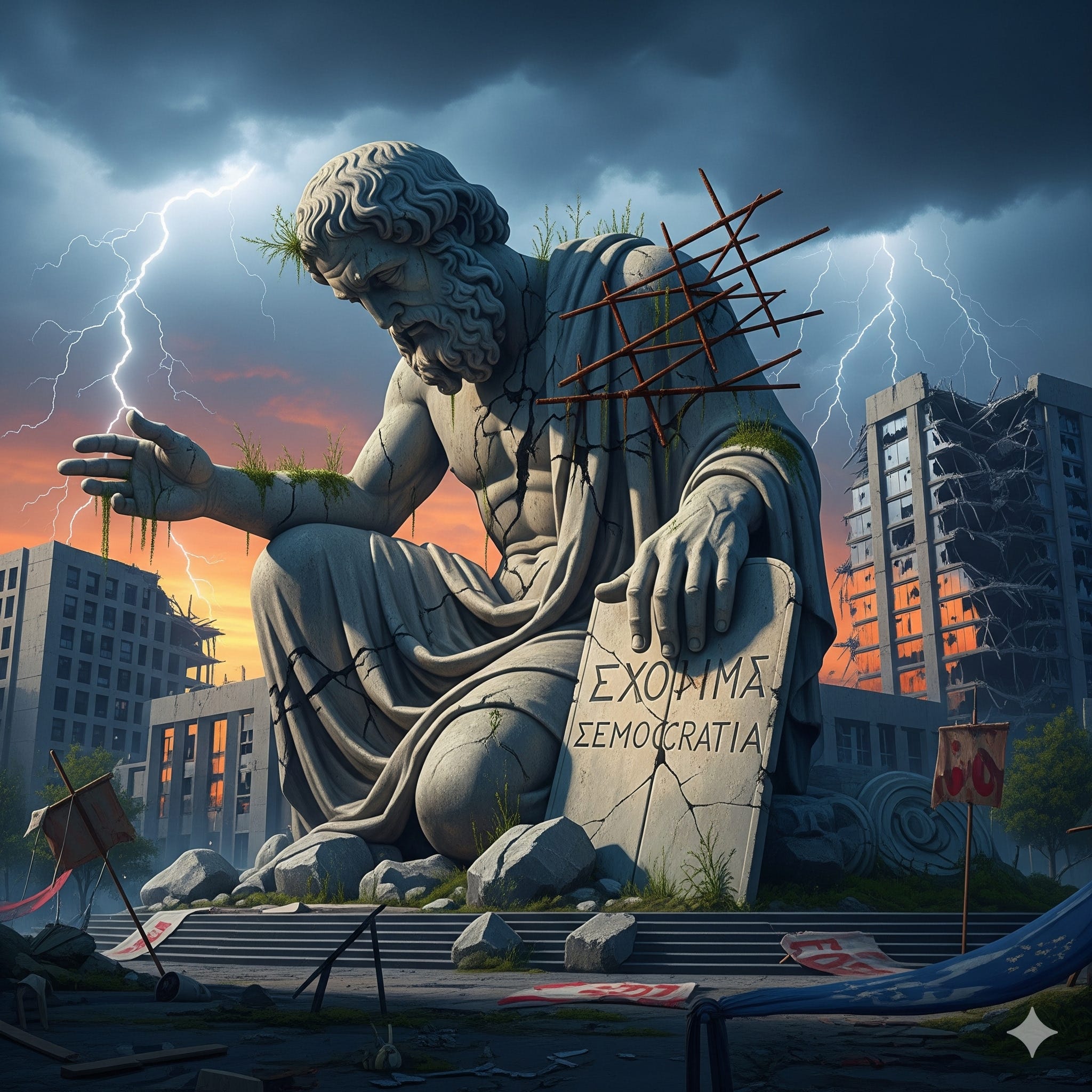
In The Republic, he bluntly described the regime's internal disease. For Plato, democracy wasn't just unstable—it was an invitation to chaos. The rule of opinion, governed by the mood of the masses, paves the way not for the statesman but for the demagogue. Not the classic tyrant, crowned by force, but the insidious despot, manufactured by rhetoric and popular flattery.
The reasoning is devastating: when truth submits to the tastes of the majority, lies become state policy. When logic gives way to emotion, politics degenerates into spectacle. And when the crowd is persuaded that freedom consists of doing whatever it wants, the natural consequence is servitude to whoever best manipulates their desires. Tyranny is born, paradoxically, from the very womb of democracy.
Plato described the figure of the demagogue with unsettling precision: a charismatic man capable of exploiting resentments and passions to govern. Today, you only need to turn on the TV or open social media to recognize their heirs. They no longer need armies, just algorithms, slogans, and an audience hungry for comforting illusions.
Our time has only sophisticated the mechanisms. The continuous news cycle, digital networks, and permanent polarization have created the perfect environment for degradation: reason drowned out by noise, information converted into propaganda, and truth diluted until it becomes unrecognizable. This is what Plato already foresaw: the confusion between truth and falsehood as the fuel for political manipulation.
The way out, for him, wasn't to replace democracy with open tyranny, but to recognize that no political order survives without education, critical reason, and ethical formation. A community that hands its mind over to entertainment and slogans isn't free: it's merely living under the sweetest of dictatorships, a "polite tyranny," polished, smiling—but a tyranny nonetheless.
The future of freedom doesn't depend on institutional proclamations but on citizens' ability to resist the comfort of a lie. Plato didn't leave us with fatalism but with a warning: democracy can survive, as long as it doesn't surrender to its own illusion.
Without ethical media, it is very difficult to inform society and live under the aegis of truth.
This explains everything…I was listening to some music and heard this:
“You can see the stars but you cannot see the light.”
This seems very fitting….